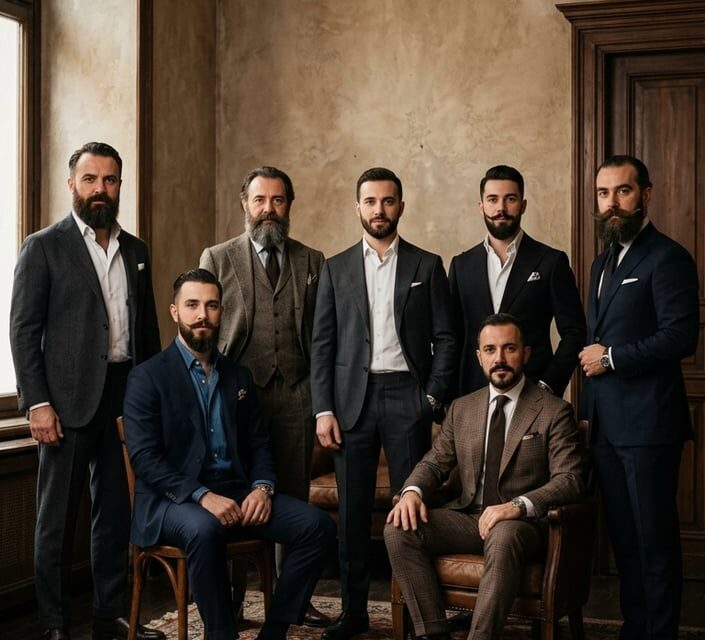
You want a beard that signals old-world craft and modern polish. This article shows seven Italian beard styles that help you sharpen your look with clean lines, deliberate fades, and chin-forward shapes that suit both casual and formal settings.
You’ll learn which classic silhouettes and modern twists fit your face and how to wear each style with confidence.
Think of these styles as a toolkit: pick the shape that highlights your jaw, control cheeklines for a cleaner profile, and use precise fading to balance fullness and definition.
1) Classic Italian Full Beard with Tapered Cheeks

The Classic Italian Full Beard with Tapered Cheeks balances fullness and control for a refined, timeless look. You keep length on the chin and jaw while softening the sides to follow your natural bone structure.
This style frames the face without overwhelming it. Tapered cheeks create a clean line from sideburns to beard, which sharpens your profile and highlights your jaw.
Maintenance focuses on regular trimming and defined edges. Use clippers to blend the sides shorter than the chin, and scissors or a longer guard to retain fullness in the center.
Wash and condition the beard two to three times weekly to prevent coarse texture and dryness. Apply a light beard oil daily to soften hair and add subtle sheen without making the beard look greasy.
Shape the neckline and cheek lines every few days to preserve the tapered effect. Visit a barber every 3–6 weeks for a professional sculpt that keeps proportions balanced as the hair grows.
PRO TIP
When deciding how much to taper, follow your cheekbones rather than copying a photo. That ensures the cut complements your face shape and looks naturally Italian.
2) Balbo with Disconnected Mustache

The Balbo with a disconnected mustache pairs a floating mustache with a sculpted beard that follows the jawline and chin. You get a look that reads intentional and refined without appearing overly fussy.
This style keeps the cheeks clean and omits sideburns, focusing attention on the chin, soul patch, and the separated mustache. The disconnection creates contrast and gives the face a defined, architectural appearance.
Grow the hair long enough to shape a solid goatee and mustache—usually a few weeks of growth depending on your hair density. Trim the cheek line and jawline precisely; sharp edges make the Balbo read polished rather than scruffy.
Use a small trimmer and a fine-toothed comb to define the gap between mustache and beard. A detail razor or clipper with a guard helps maintain the clean space under the nose and above the beard.
If your face is round, the vertical emphasis on the chin helps elongate your profile. For square or angular faces, soften sharp jawlines by keeping the beard length moderate and the mustache neatly rounded.
PRO TIP
Apply a light beard oil to the beard and a small amount of mustache wax to shape the floating mustache. The oil tames frizz and keeps the beard looking healthy while wax lets you control the mustache without making it stiff.
3) Short Boxed Italian Beard with Sharp Jawline Fade

The short boxed Italian beard pairs neat fullness with crisp edges to give you a polished, professional look. It keeps hair close to the face while preserving a defined chin and mustache, which suits square and oval face shapes particularly well.
You maintain a short length across the cheeks and chin, then blend into a precise jawline fade that accentuates your bone structure. The fade usually tapers from the sideburns down toward the jaw, creating a clean contrast between skin and beard without losing overall fullness.
Daily grooming keeps this style sharp: light beard oil for softness, a comb to train hairs, and a trimmer for edge maintenance. Expect to clean up the neckline every few days and perform a fuller trim every week to ten days to hold the shape.
This style works well for professionals and anyone who wants a refined Italian-inspired appearance without heavy growth. It reads as intentional and well-groomed, so it complements tailored clothing and neat haircuts.
PRO TIP
When shaping the jawline fade, shave or clip below the Adam’s apple to create a natural lower boundary. Use a shorter guard on the trimmer at the sides and a slightly longer length on the chin to keep the “boxed” silhouette balanced.
4) Chin-Focused Italian Pointed Beard (Virile Chin Puff)

The chin-focused pointed beard centers attention on a sculpted chin puff that tapers to a subtle point. It evokes an old-world, Mediterranean sensibility without requiring a full beard.
You keep cheeks clean or very lightly stubbled while allowing length and density at the chin. This contrast frames your jaw and lengthens the face, which suits oval and square shapes especially well.
Trim the sides short and blend carefully into the jawline for a polished look. Use a precision trimmer to define the point and scissors to remove stray hairs for a natural taper.
Maintain a clear mustache separation or a very narrow connection if you prefer more definition. That gap reinforces the chin as the focal point and preserves the traditional “virile puff” aesthetic.
Care for the beard with a light oil to prevent dryness and to keep the point soft rather than wiry. Comb daily to train growth downward and to maintain the tapered silhouette.
PRO TIP
If your chin growth is patchy, let the center grow a bit longer while keeping the surrounding area tidy; length can make density appear greater.
5) Clean-Shaven Cheekline with Heavy Chin Strap

The clean-shaven cheekline paired with a heavy chin strap creates a striking contrast that frames your jaw with clear intent. You keep the cheeks bare, which sharpens the overall silhouette and draws attention to the defined band of hair hugging the jawline.
A heavy chin strap is thicker than the classic thin line and often covers the jaw from ear to ear or concentrates weight along the chin. This adds visual strength to a square or oval face, and it can balance a longer nose or higher forehead by grounding the lower face.
Maintain crisp edges by shaving the cheeks and neck daily and trimming the strap with a precision trimmer. Use a shorter guard to keep the strap uniform; then shape the lower edge with a bare blade for a clean, intentional line.
If your hair density varies, you can thicken the strap at the chin to create symmetry and hide sparse patches. Regular checks in natural light help you catch uneven growth and keep both sides balanced.
PRO TIP
Comb the strap down and trim against the grain for consistent length before defining edges. Apply a light balm to keep the skin under the strap healthy and reduce irritation from frequent shaving.
6) Disconnected Pencil Mustache and Goatee (Modern Mediterranean)

The disconnected pencil mustache and goatee pairs a thin, carefully shaped mustache with a separate, defined goatee. You keep a clear gap between the two, which creates a refined, sculpted look that reads both classic and current.
This style emphasizes precision. The pencil mustache requires steady trimming and a steady hand to maintain its slim profile, while the goatee benefits from a slightly fuller, well-contained shape at the chin.
Face shape matters: this combo flatters oval and angular faces by drawing attention to the mouth and chin. If you have a rounder face, keep the goatee slightly elongated to add vertical definition.
Maintain contrast by shaving the cheeks and jawline closely; that separation is what gives the style its “disconnected” character. Use a quality trimmer for clean edges and a fine-tooth razor for the mustache line.
PRO TIP
Train the mustache hair with a tiny amount of beard balm or wax to keep it lying flat and sharply edged. Trim weekly and step back often—checking symmetry in natural light helps avoid uneven lines.
7) Vintage Verdi-Inspired Rounded Beard

The Vintage Verdi-Inspired Rounded Beard pairs a full, rounded chin with a distinct, styled moustache. You get an elegant silhouette that nods to 19th-century Italian fashion while remaining wearable today.
Grow the beard to medium-full length beneath the chin, keeping the sides shorter and neatly tapered. Aim for a soft, rounded bottom rather than a point; that shape creates the signature Verdi profile.
The moustache plays a starring role. Let it grow thick and comb it to the sides or give the ends a subtle curl for a classic finish that balances the rounded beard.
Trim regularly to maintain the rounded outline and prevent bushiness along the cheeks. Use scissors for shaping the lower curve and a clipper with a longer guard to blend the sides into the jawline.
Keep the hair healthy with a beard oil or balm that provides light hold and shine. A boar-bristle brush or fine-tooth comb helps train the moustache and smooth the beard without flattening the rounded shape.
PRO TIP
If your face is square, soften the angles by keeping more fullness under the chin and trimming the cheek lines higher. For round faces, maintain slightly shorter width at the chin to add visual length to your face.