A rigid hardtail, a candy-green tank he powder-coated himself, stock points and a capacitor, and a long-running friendly build-off with a mate. Jeff Hart’s first chopper is the kind of XS650 build this site exists for.
Owner: Jeff Hart · Bike: 1983 Yamaha XS650 · Style: Rigid hardtail chopper
Some builds start with a plan and a parts list. Jeff’s started with a shape he couldn’t stop thinking about. “I always loved the look of a parallel twin,” he told us when he sent in these photos. “The British motors were hard to come by.” So he went looking for the next best thing — and in the XS650 he found something arguably better: the same upright, finned, twin-cylinder silhouette, a pair of carbs hanging off the back, and a parts network that means you can actually finish the bike instead of hunting swap meets for a decade.
What he ended up with is a low, stretched, kick-only hardtail in a green that photographs like a boiled sweet — and a bike that, by his own account, “turns heads everywhere.” Not bad for a first chop.
The donor: a salvage-titled ’83
Jeff’s starting point was a 1983 XS650 with a salvage title. That’s not a detail to gloss over — it’s exactly why this build makes sense. The XS650 is a 653cc, air-cooled, single-overhead-cam parallel twin that Yamaha built from 1970 through 1983, turning out somewhere in the region of half a million of them. It is, in other words, one of the most plentiful and best-supported Japanese twins ever made, with a healthy aftermarket that has never really gone away.
A bike with a salvage title is never going to be a concours restoration. It is, however, a perfect donor for a frame that’s about to be cut in half. Jeff bought the ’83 and went straight to the two names most XS650 builders end up dealing with: TC Bros for chopper chassis hardware, and Mike’s XS for the model-specific parts that keep these engines alive.
Hardtail and stance
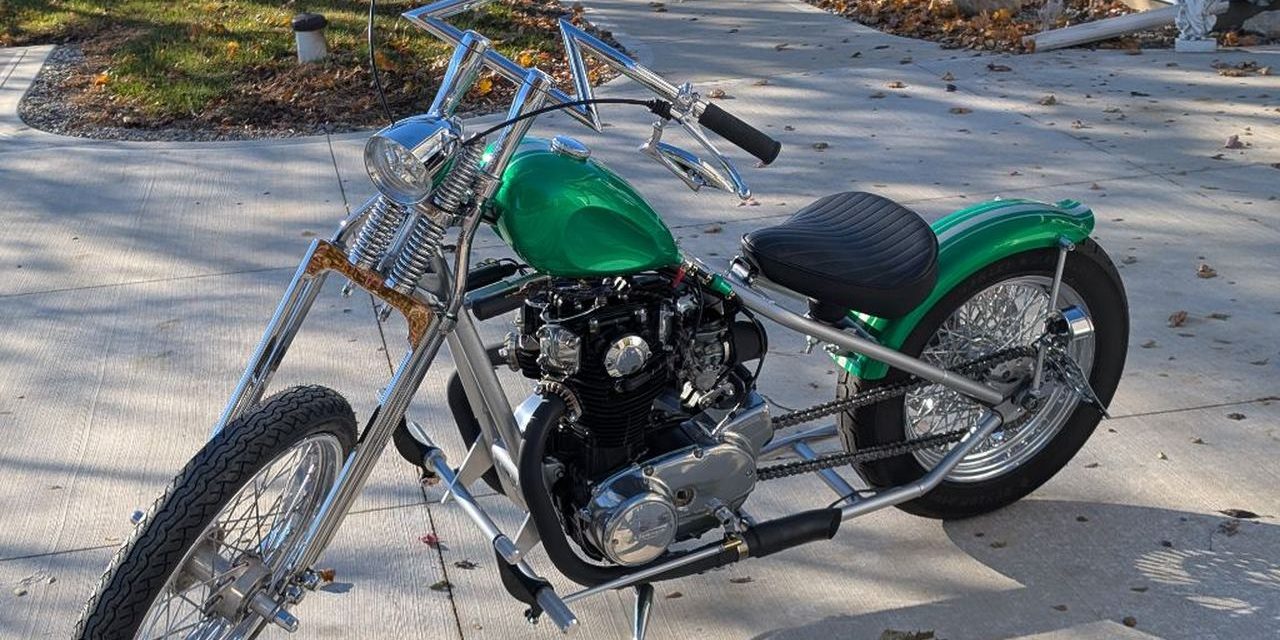
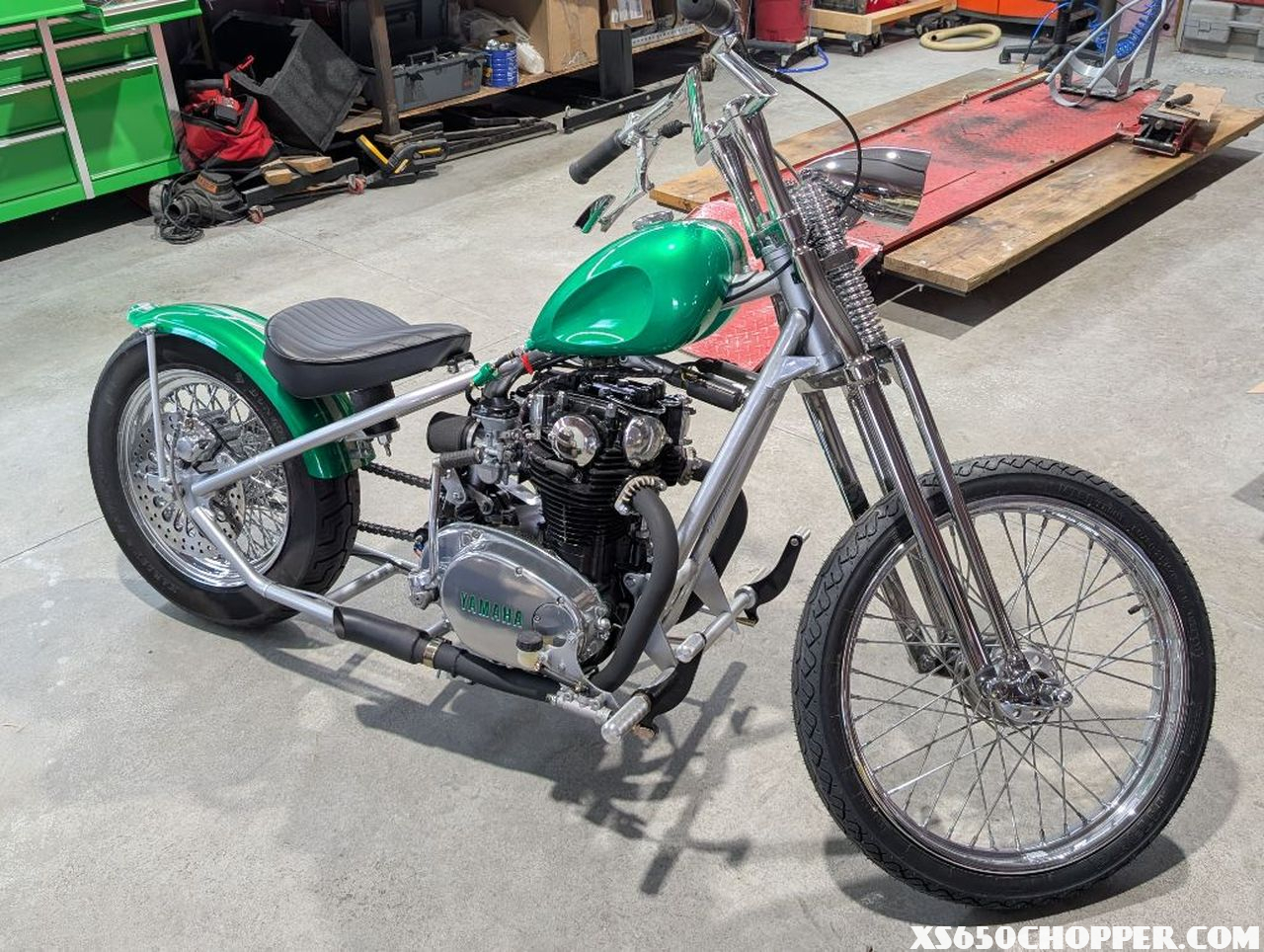
The biggest single decision on any chopper is what happens behind the gearbox. Jeff went rigid. The frame wears a weld-on hardtail — TC Bros’ XS650 kit is the default choice for this job, adding three inches of stretch while keeping the stock wheel, spacers and chain adjusters usable — and it’s finished in a clean silver that lets the green bodywork do all the talking.
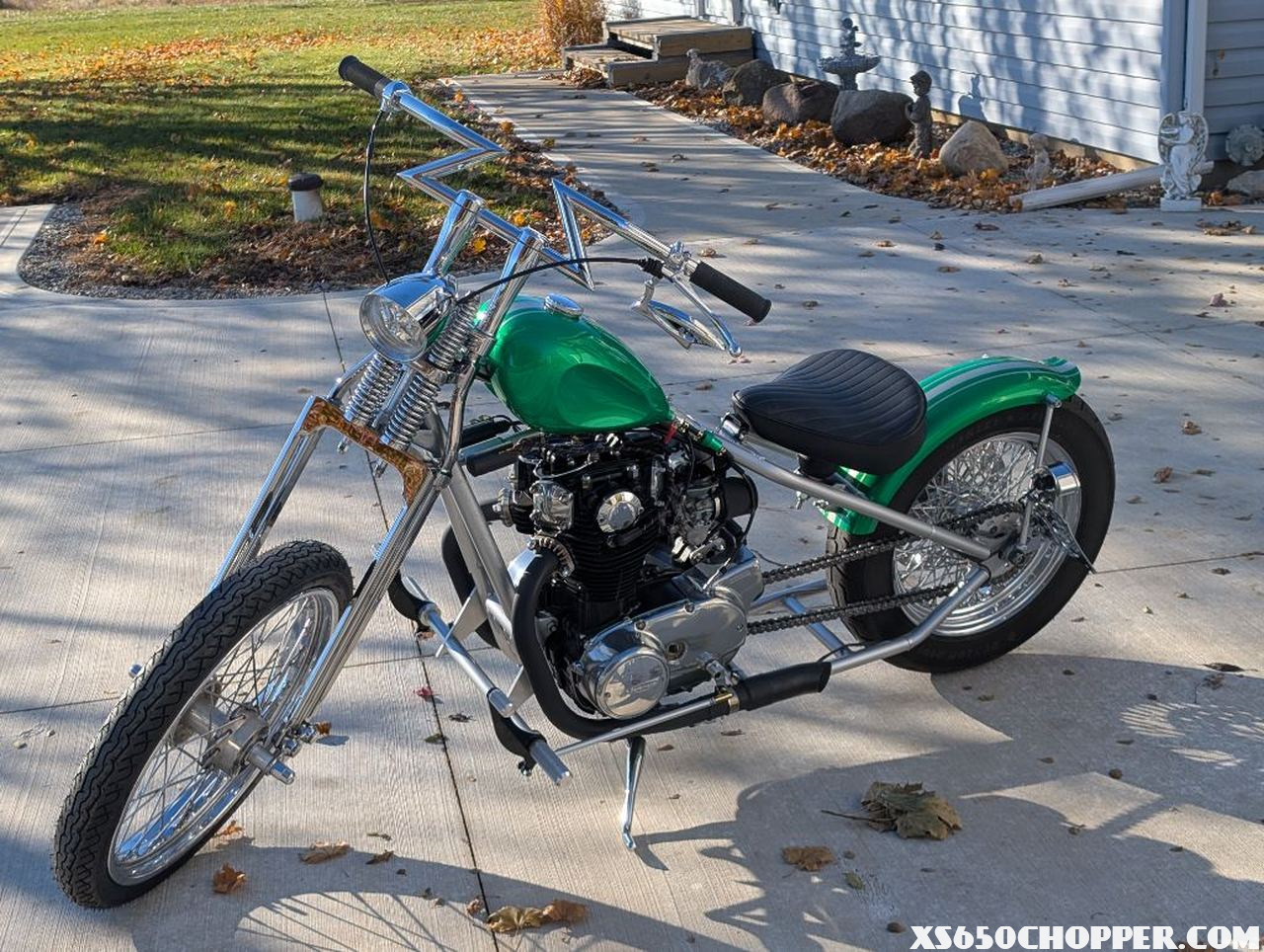
Up front, the bike runs an extended chrome springer, and this is where the proportions really come together: a tall, skinny 21-inch wire wheel on a spool hub with no front brake at all, and a fat 16 out back carrying a drilled rear disc. Narrow bars with a hard zig-zag bend — the classic Z-bar shape — sit on tall chrome risers, with a single mirror tucked underneath the left grip and a small chrome bullet headlight perched between the springer’s exposed springs.
It’s a deliberately impractical front end, and that’s the point: a brakeless spool hub is the cleanest thing you can bolt to a chopper. The stopping happens at the rear wheel, on the disc, with the engine doing backup duty.
Teaching himself powder coat, one part at a time
Here’s the part of the story we like best. Rather than farm the finish out, Jeff got into powder coating himself — and then did the three pieces that define the whole look: the tank, the rear fender and the engine cases.
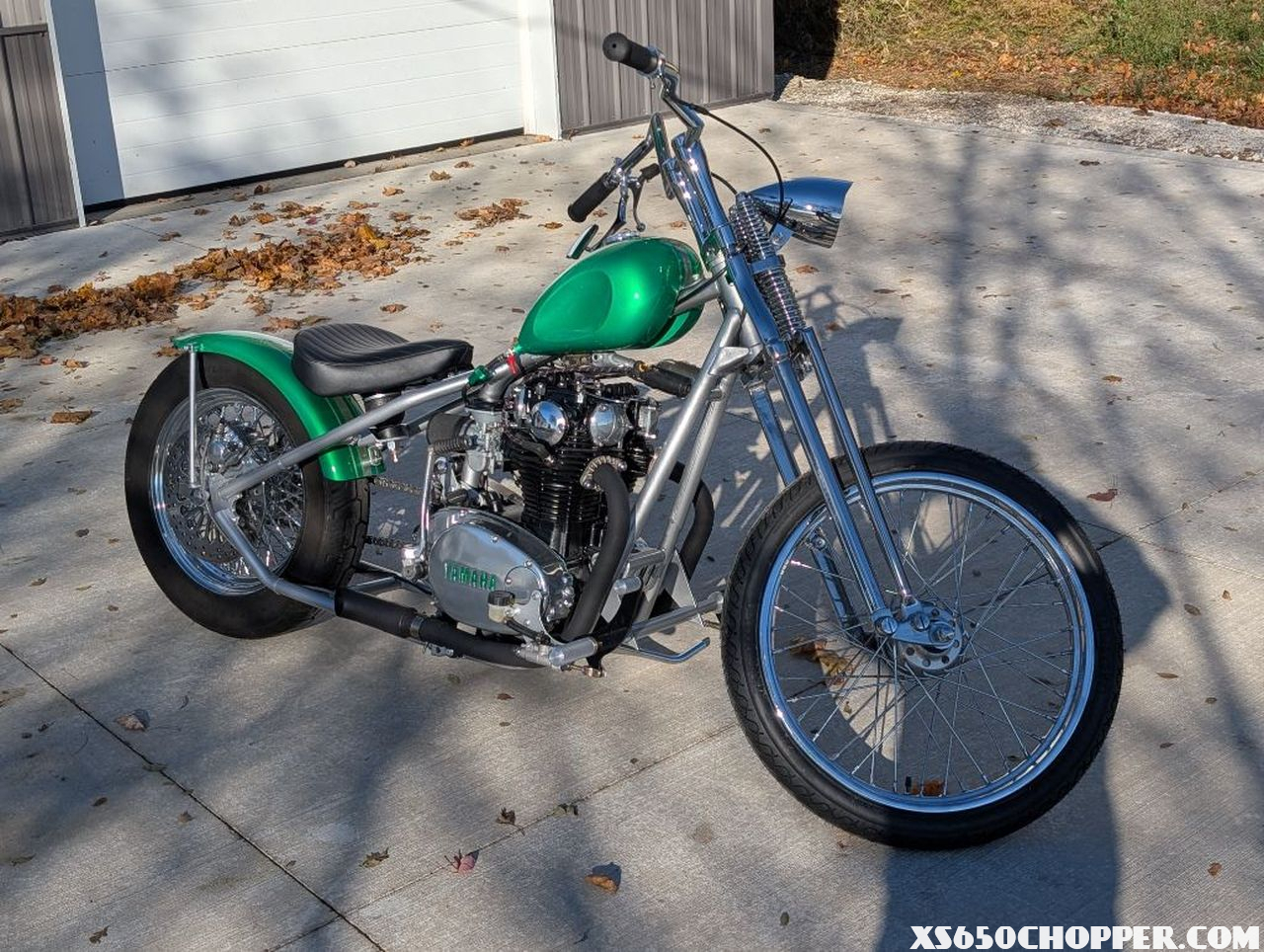
The tank is a small peanut-style unit with deep side scallops, and the rear fender is bobbed tight to the tyre and hung on twin chrome struts off the axle plates. Both wear the same metallic green, and the fender carries a pair of silver stripes down its spine. Because he sprayed the cases too, the engine doesn’t read as an untouched donor lump sitting in a custom frame — the black barrels and heads are there, but the polished side covers and the green-filled YAMAHA lettering on the clutch cover tie the motor into the paint scheme. That’s the detail most first-time builders skip.
The seat is a low solo saddle with horizontal tuck-and-roll ribbing, sitting on the frame rails right where the fender begins, and the foot controls are forward-mounted on machined pegs. The exhaust is a two-into-two system in matte black ceramic, routed low along the right side and ending in short, straight-cut tips. Out back, the twin carbs breathe without the bulk of a stock airbox, and an exposed chain runs the long way back to the rear sprocket.
Stock points, a capacitor, and no button
Where a lot of builders go modern with an electronic ignition and a lithium battery, Jeff went the other way — and it’s a choice that suits a rigid chopper perfectly.
He kept the stock points system, and he runs a capacitor in place of the battery. On an XS650 that’s the classic battery-delete recipe: the capacitor gives the ignition something to work with, the charging system takes over once the engine is running, and the whole electrical system sheds a heavy, awkward box that has no obvious home on a hardtail. The bike is kick-start only. No solenoid, no button, no starter motor — just the lever on the right and a ritual every time you want to ride.
“I left the stock points system in and used a capacitor. Kick start only.” — Jeff
The build-off with a friend
There’s a second bike in this story, even though it doesn’t appear in the photos. A friend of Jeff’s had started an XS650 build years earlier and never finished it. The two of them ended up in what Jeff describes as “kind of a biker build-off thing” — two mates working in parallel, comparing ideas, arguing about stance and finish, and quietly keeping score.
That’s the best possible environment for a first build, honestly. You get a second opinion on your rake angle, someone to tell you your bars are too tall, and a reason to keep going when the wiring is on the floor and nothing works.
“My friend had started one years ago but never finished it. We had kind of a biker build off thing going. It was cool comparing build ideas.” — Jeff
How it rides
Jeff’s verdict on the finished bike is refreshingly short on drama: “This thing is fun to ride and turns heads everywhere.” Which is roughly what you want from a hardtail chopper. It won’t be the bike you take on a 400-mile day — no rear suspension, a solo saddle, forward controls and a brakeless front wheel all see to that — but as a short-haul, sunny-Sunday, ride-it-to-the-diner machine, it does exactly what it’s supposed to.
The photo setting says as much as the spec sheet: a suburban driveway, autumn leaves scattered across the concrete, low sun throwing hard shadows. No studio lights, no turntable. Just a bike that gets ridden and parked outside a house.
The build at a glance
(paste as a two-column Table block — left column labels, right column details)
| Donor | 1983 Yamaha XS650, salvage title |
| Engine | 653cc air-cooled SOHC parallel twin; black barrels and heads, polished covers, green-filled YAMAHA lettering on the clutch cover |
| Frame | Weld-on hardtail, silver finish, stretched and raked |
| Bodywork | Peanut tank with side scallops and bobbed rear fender, both powder-coated metallic green; silver stripes on the fender |
| Front end | Extended chrome springer fork, chrome bullet headlight, chrome Z-bars on tall risers, single low mirror |
| Wheels | 21-inch wire front on a spool hub, no front brake; 16-inch wire rear with drilled disc |
| Seat and controls | Solo tuck-and-roll saddle; forward-mounted foot controls on machined pegs |
| Exhaust and intake | Two-into-two matte black ceramic pipes, low right-side routing; twin carbs without a stock airbox |
| Ignition | Stock points, capacitor in place of the battery, kick start only |
| Parts sources | TC Bros and Mike’s XS, plus Jeff’s own powder-coat work |
Details above are read from Jeff’s three photographs and his submission notes; where a component isn’t clearly visible we’ve left it out rather than guessed.
Turned out just fine
First builds are usually a list of things you’d do differently. Jeff’s summary of his is one line, and it’s the right one: “I think it turned out just fine.”
It’s a bike built with the two things that matter most on an XS650 project — a donor nobody will mourn if you cut it up, and a parts supply that lets you keep going — and finished with a skill he taught himself along the way. The green is his. The powder coat is his. The kick is his, every single time.
If you’ve got an XS650 build sitting in the garage, finished or half-done, we want to see it. Send us your photos and the story behind them and it could be the next one featured here.